
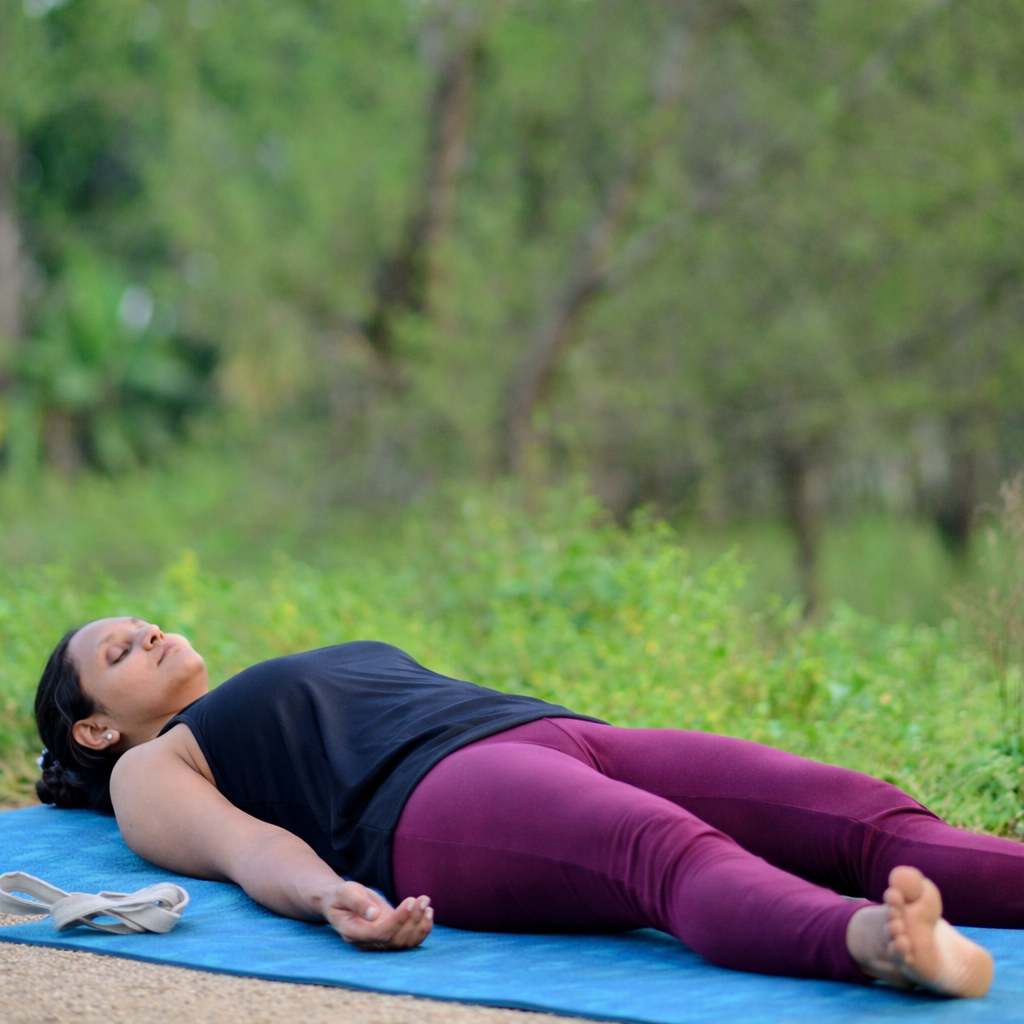
Recently, one of my students asked a beautiful question:
“Can we learn more about Shavasana? Not just practice it, but understand it deeply?”
That question made me happy.
Because yoga is not only about moving the body. It is about educating ourselves in what we practice. When knowledge supports experience, transformation becomes conscious.
I truly feel grateful to have students who want to grow not just through physical sessions, but through understanding. This is how inner transformation begins — with curiosity.
Today, we dedicated 45 minutes to understanding Shavasana, followed by 10 minutes of Sukshma Vyayama to gently awaken the body again. And what unfolded was powerful.
Let us explore why.
Shavasana in the Hatha Yoga Pradipika
In the classical text Hatha Yoga Pradipika, Chapter 1, Verse 32, Shavasana is described as:
उत्तानं शववद्भूमौ शयनं तच्च शावासनम् ।
शवासनं श्रान्तिहरं चित्तविश्रान्तिकारकम् ॥ ३२ ॥
Transliteration:
Uttānaṁ śavavad bhūmau śayanaṁ taccha śavāsanam |
Śavāsanaṁ śrāntiharaṁ cittaviśrāntikārakam || 32 ||
Meaning:
Lying flat on the ground, like a corpse, is called Shavasana.
It removes fatigue and brings deep rest to the mind.
This verse is simple — yet profound.
Why Shavasana Is Not “Just Lying Down”
At first glance, Shavasana appears effortless. You simply lie down.
But most people find it difficult to completely relax.
Even when the body is still, there is unconscious holding:
- Tightness in the jaw
- Shoulders slightly lifted
- Abdomen contracted
- Breath shallow
- Mind continuously active
True Shavasana is not sleep.
It is conscious relaxation.
When the whole body relaxes deeply:
- The breath slows naturally
- The nervous system resets
- The mind begins to quiet
- Awareness turns inward
This is where pratyahara — the withdrawal of senses — begins naturally.
The Two Levels of Healing
The verse clearly mentions two benefits:
1. Shranti-haram — It removes fatigue.
This refers to physical exhaustion. After asana practice or a busy day, Shavasana restores energy.
2. Chitta-vishranti-karakam — It gives rest to the mind.
This is deeper. The waking mind that constantly thinks, plans, and reacts begins to soften.
When the mind relaxes, suppressed impressions may gently surface — not to disturb us, but to release. This is why Shavasana is considered beneficial in managing stress-related and psychosomatic conditions.
Though it is a static posture, it revitalizes the entire system.
The Symbolism of “Shava”
“Shava” means corpse.
In Shavasana, we symbolically drop:
- Ego
- Roles
- Identity
- Effort
- Control
For a few minutes, we surrender.
Not in weakness.
Not in dullness.
But in awareness.
This conscious surrender prepares the practitioner for Dharana (concentration) and Dhyana (meditation).
If we cannot relax deeply, we cannot meditate deeply.
From Practice to Transformation
In our session, after exploring Shavasana deeply for 45 minutes, we followed it with 10 minutes of Sukshma Vyayama — gentle movements to reawaken the body with awareness.
The experience was different.
Because when we understand what we are doing, the practice becomes intentional.
Yoga is not mechanical repetition.
It is intelligent participation.
And I feel truly grateful to guide students who wish to learn, question, and evolve.
This is how transformation takes place —
Not by doing more, but by becoming more aware.
A Reflection for You
Next time you lie down in Shavasana, ask yourself:
Am I simply resting?
Or am I consciously surrendering?
Let gravity hold you.
Let breath move naturally.
Let awareness remain.
Shavasana is not the end of practice.
It is the doorway inward.

